RK: 100 Years of Greatness


I am not a great fan of Raj Kapoor, despite being aware of his great contribution to Indian cinema. Without any perceptible cause for dislike, I just never got around to liking him much. So, I rather surprised myself when I suggested that my 'Bitter Half' book tickets to Awāra, which was being screened as part of the film festival organised to commemorate Raj Kapoor’s birth centenary. As my 'Bitter Half' had tried unsuccessfully for a few years to convince me to watch Awāra on the small screen, he naturally took me at my word and immediately booked the tickets at PVR, Juhu, for December 13, 2024 (for the 6:45 pm show). Feeling rather magnanimous I also encouraged him to book tickets to Shree 420 for December 14 (which we watched at Fun Republic, Versova, at 6 pm). While watching Awāra it struck me that I was a first time viewer of this movie, and that as I was doing this 73 years after its release this made it a once in a lifetime opportunity. So, I asked my 'Bitter Half' to book tickets to Barsaat as well, which was another movie I hadn’t watched. (We watched that one again at PVR, Juhu, on December 15, at the 6:45 pm show). So, in spite of not liking Raj Kapoor overmuch, I ended up watching three of his movies in as many days.
The following are my impressions of the movies:
Acting — Unlike in the movies of this era, the main actors displayed a markedly fresh and natural on-screen presence. There were no stylised gestures; no over-the-top or melodramatic histrionics marred their performances. Raj Kapoor and Nargis portrayed the quintessential lovers and soulmates. In both Awāra and Shree 420 Nargis’ characters save the floundering heroes and lead them to become better versions of themselves. They both showed up as fine actors. I found it difficult to decide which of Raj Kapoor’s persona’s I liked best: as the street-smart pick-pocket of Awāra, as the man tempted to unscrupulous ways in Shree 420, or as the sensitive poet of Barsaat. Nargis is genuine in each of her roles: as the sophisticated Rita in Awāra, the girl-next-door Vidya in Shree 420, and the simple village beauty Reshma in Barsaat. The amazingly handsome Prithviraj Kapoor’s performance in Awāra of a man tortured by the demons of his past is truly grand. I was even pleasantly surprised by the handsome, tall and lithe Prem Nath’s on-screen presence in Barsaat, where he effortlessly portrays a suave young man-about-town, ruled by the desire to seek and take his pleasure where he can find it. As I was familiar with his later appearance of an overweight and stereotypical Bollywood villain, this avatar was charming indeed, and I could now more easily visualise him as the love interest of the beautiful Madhubala in movies like Badal or Saqi (both of which I may be now willing to watch). The 13-year-old Shashi Kapoor quite confidently portrays the younger RK in Awāra, thus proving that acting skills and screen presence are hereditary in the Kapoor clan. Leela Chitnis’ performance was fair enough as a mother in Awāra, but Lalita Pawar quite steals a march on her in the maternal department in Shree 420. Her portrayal of a cheerful and loving aged banana-seller who is charmed by the refreshing naïveté of the young man who insists on trying to buy 2 bananas for 3 annas instead of the price of 3 bananas for 2 annas which she had quoted is wonderful. She convincingly portrays the healing power of woman’s love and nurture, and her great capacity for soothing away the pangs of life’s disappointments. K. N. Singh plays the bad guy in both Awāra and Barsaat, and in both his performances are completely different. Where in Awāra he is a crime lord driven to exact revenge on the son of the man who has been responsible for ruining his life, in Barsaat he is an innocent simpleton who, childlike, tries to secure the love of a woman by resorting to extreme measures and ends up getting arrested. In contrast, Nemo (Mirza Muhammad Baig) plays the capitalist bad guy in Shree 420, managing to portray a rich, unscrupulous tyrant. Unlike the bad men Singh portrays in Awāra and Barsaat, Nemo’s character has chosen to rise to a life of riches and power through exploiting the poor innocents who seem powerless to stop him. The final message of Shree 420, which may seem idealistic in retrospect but is entirely true to the communist ideology, is that such capitalist tyrants would be, and should be, defeated by the power of a united proletariat. Nadira’s negative character of Maya in Shree 420, is also remarkably assayed in all its utter selfishness and greed. The only bad actor in these three movies was Nimmi. Even though Barsaat was her first movie and allowances should therefore be made for her, I found her performance tedious in the extreme. Having never liked Nimmi to begin with, I was even more irritated by her wooden and stylised gestures. She continued to grate on my nerves throughout her teary-eyed appearances until she mercifully committed suicide. Had I not been in a movie theatre I might have cheered loudly at finally being rid of her. The relatively unknown junior artist, Vimla Kumari, who appears in the song ‘Hawa Mein Udta Jaye’ portrayed emotions much better than Nimmi.
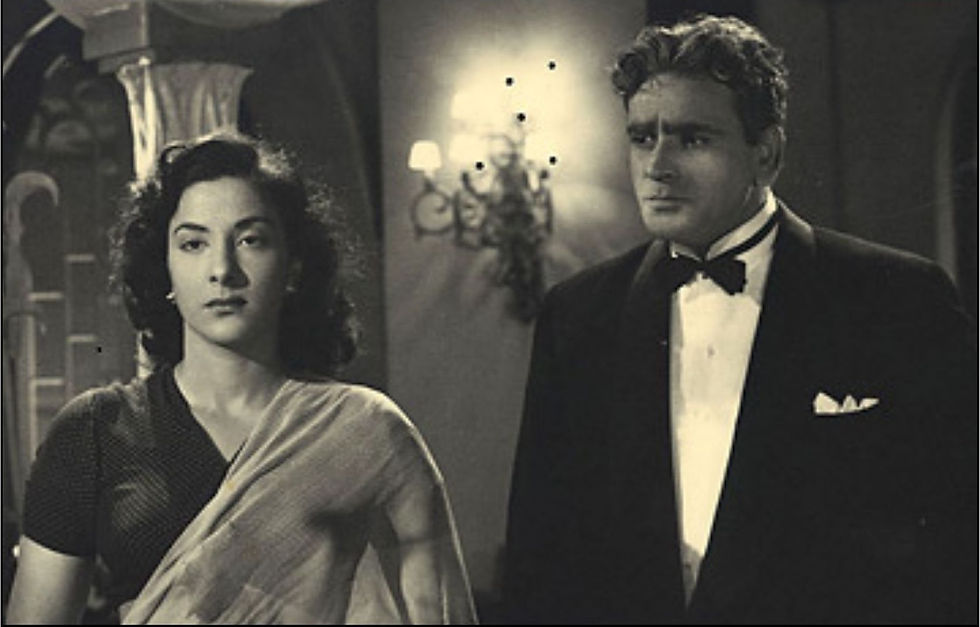
Plot — While Barsaat is a love story (and so seemed to drag somewhat), Awāra and Shree 420 portray the struggles of the middle and lower classes to grasp the promised prosperity in a newly-liberated country. The dazzling dreams of splendour for all in a democratic India had failed to materialise and the fate of the multitudes seemed largely unchanged in spite of the changed political status of the country. The old, foreign masters seemed to have been replaced by new, home-grown tyrants. Raj Kapoor’s famously communist ideological sympathies are apparent in these and other movies like Jagte Raho and Boot Polish (to only name two). I felt Shree 420 was more idealised as compared to the stark vision of Awāra; yet, both had a frank message to deliver about the corruption in high places and the feeling of disenchantment experienced by the proletariat. This message cared nothing for the establishment’s wishes and only sought to make the masses aware of their rights. This no-nonsense attitude seems to have become blunted in later RK productions as Raj Kapoor began playing to the galleries and objectifying women in an effort to gain commercial success. The absence from his life of his Muse, Nargis, seems to have driven him to vent his hurt, anger and frustration on all the women he encountered or cast thereafter. The brash exposure of female flesh in Bollywood was a trend that he started; sad, indeed, that such a sensitive artist stooped so low to gain audiences.
Persona — On the whole, seeing the movies with the benefit of 70 years’ worth of hindsight obviously does make a difference to one’s appreciation of the craft. Raj Kapoor does not feel compelled to hog the screen (unlike other great actors such as Dilip Kumar or Amitabh Bachchan). For instance, in Awāra, the young Shashi Kapoor enjoys a good half hour of screen time before Raj Kapoor makes an appearance as his older avatar. In the opening credits in these three movies Nargis’ name (and Nadira’s in Shree 420) appears before Raj Kapoor’s own (this was decades before SRK and his Women’s Day pledge to ensure his female co-actors’ names were billed before his own). I think Raj Kapoor was also the first to feature the names of playback singers in the opening credits in Awāra, and even featured the names of the chorus vocalists in the credits of Shree 420. His communism was not simply theoretical, then; he sought to provide recognition to those who usually went unrecognised in the great scheme of things.

Music — Nearly three quarters of a century later after these films were first released — Barsaat (1949), Awāra (1951), Shree 420 (1955) — they retain their youthful charm. The plots progress steadily through the dialogue and songs. Music, which was an extremely strong suit in RK movies, is among the best Shanker-Jaikishen scores from the golden era of Hindi film music. To a person like me, the charm of the 1950s, ‘60s, and to some extent the ‘70s films lies chiefly in their music and songs. To me RK’s films had been the setting in which were embedded some of the most precious gems of Hindi film music. However, while watching Awāra and Shree 420 I felt slightly disorientated. I repeatedly found myself so caught up in the plot itself that when the beloved songs did appear they did not seem to be the main events; rather, they complemented the plots perfectly and fulfilled the function that music is actually expected to perform in Indian dramaturgy — that is, to support the plot and create the appropriate mental state in the audience to receive the message of the film or drama. One also finds the tunes of many of the songs that appeared in later RK’s films feature as refrains in these earlier films: for example, ‘Theher Jara O Janewale’ (which appears as a mukhda with lyrics), ‘O Basanti Pawan Pagal’, ‘Na Chahoon Sona Chandi’ (in Awāra); ‘Jane Kahan Gaye Woh Din’, ‘Sunte The Naam Hum’ (in Barsaat); ‘Kisiki Muskurahaton Pe Ho Nisar’ (in Shree 420). These testify to the musical genius of Raj Kapoor.

All the shows we watched were sold out, and while most of the audience comprised older members, there were younger viewers, too. However, what both my 'Bitter Half' and I found most conspicuous by its absence was the lack of any promotional material on Raj Kapoor. We had hoped to take at least a selfie with Raj Kapoor’s cutouts or posters, but there were none to be found. The two theatres where we watched the movies had nothing to show any passersby that these theatres were participants in the RK Film Festival. I had expected some of the numerous books about Raj Kapoor and his life and times might be on display and sale — absolutely nothing. My 'Bitter Half' also bewailed the absence of a short film (at least a few minutes long) about Raj Kapoor himself, which could easily have been screened during the interval and would have provided valuable information to those new to his charisma. RK memorabilia could also have been of interest to those who wished to possess something more concrete with which to remember the centenary festival. Screening his films was a nice effort; but the Kapoors might have put a little more thought into the PR exercise, and could thus have ensured passing on the legacy of their legendary forbear in a more meaningful manner.


V